

On Life in Canada - Part Two: Joys
Last time, we had a public vent about everything that gets on our nerves here ranging from minor annoyances to things that, so to speak, make us flip out :) I’m fulfilling the first of my blog promises, so this post will be all cotton candy, puppies, unicorns, and so forth…
Canadians are Nice
Is it a cliché? A stereotype? Probably, but it's 100 percent true. Whether it's the pizza delivery guy, the receptionist, a grocery cashier, or even a random passerby on the street, everyone here is simply wired to sincerely want to help you. It's not that you wouldn't find such people in Slovakia, but there's a fairly high chance that the person in question would at least cuss you out under their breath before doing what you need. Believe me, I drink and I know things (and I also worked in HR for six years; I could write a separate blog about various types of sociopaths and weirdos). I must admit that this life optimism is slowly but surely rubbing off on me, and it already feels quite normal to engage in small talk and loudly praise things I like. Me—the person who always fought against this on all fronts and held the opinion that if I have nothing to say, I’d rather stay silent.
The embodiment of Canadian kindness is also our neighbors from the floor above. After seeing us exactly once in their lives and finding out we were new here and without family, they invited us without hesitation to their Easter table for a festive lunch, and immediately to a family celebration a week later. They also constantly emphasize that we shouldn't dare buy expensive sports equipment—they’ll lend us camping gear and bicycles anytime. And they do it just like that, out of goodwill. Because that's how it should be.
I often wonder how they would feel in the Central European region. Being closed off and having a certain "preset" for the negative sides of life is far from being just a Slovak thing. And as my friend from Poland said: smiling at a stranger on the street? That’s an offense punishable by deportation!
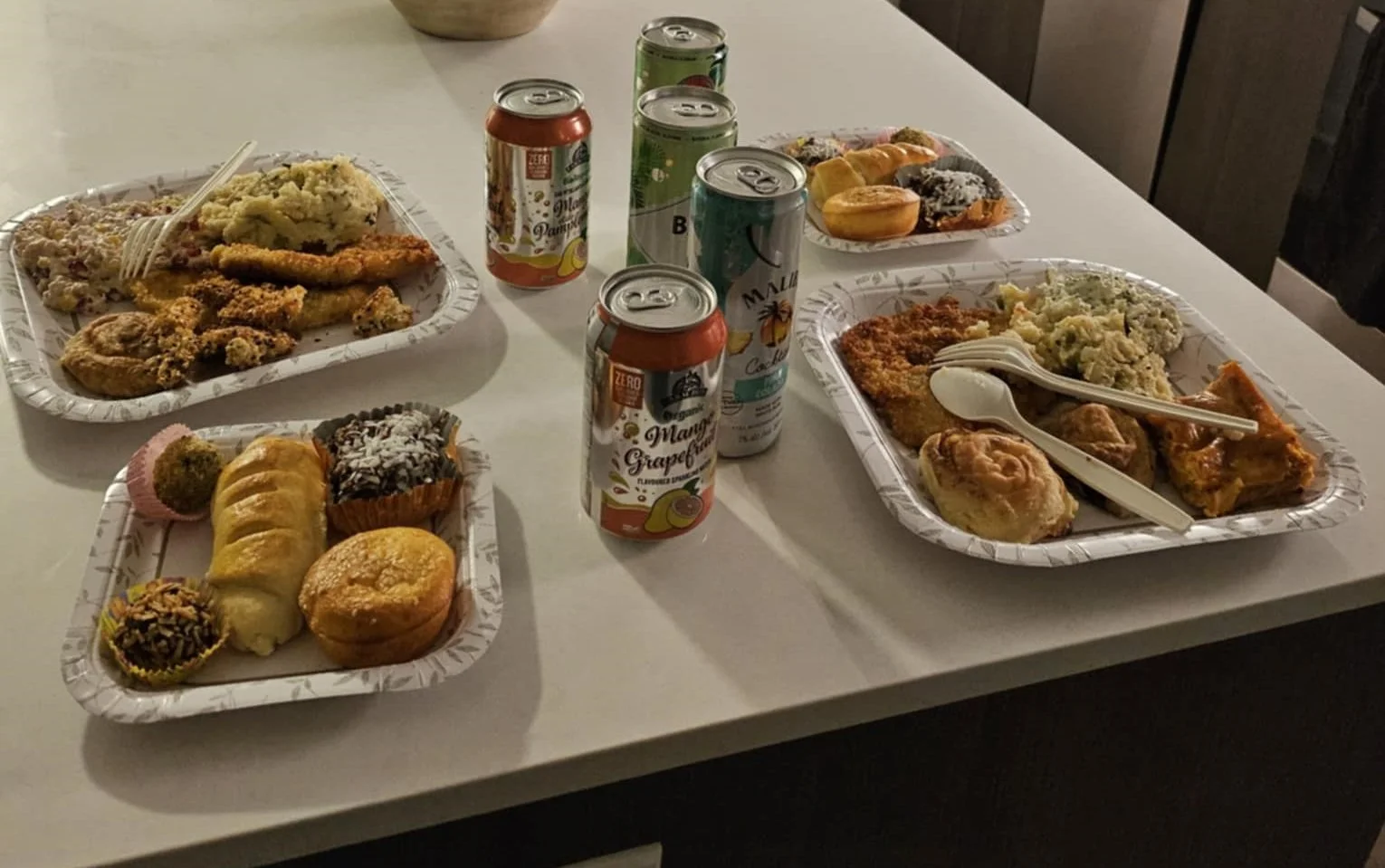
A doggie bag from the mentioned celebration. Our neighbor's son-in-law is from the Balkans, so we got to enjoy great homemade burek and cakes.
2. Selection in Shops
Sometimes less is more. That definitely doesn't apply to grocery stores here. Whether you go to the gigantic Real Canadian Superstore or a smaller grocery shop, the fundamental rule is that an incredible selection awaits you. Looking for a special fruit or vegetable? Don't know yet if you want to eat something Mexican, Thai, Polish, or Indian? Cheese, olive, or sesame pastry—or maybe just "everything" to be safe? None of that will be a problem in Canadian groceries. The problem we have is more that every single shopping trip always takes longer because we get stuck in one of the aisles discovering new products. And our personal highlight? A pharmacy right inside the grocery store. For that, we even forgive the alcohol restrictions (groceries don't have a license to sell hard liquor).
Canadian Tire deserves a category of its own. A store that truly started 100 years ago selling tires has over time become an inseparable part of the local shopping culture. These days, you can still buy tires there, but also, among other things: tools, sports equipment, furniture, home accessories, pet supplies, fishing gear, hockey merch, electronics, workshop equipment, kitchen utensils, drugstore items, car care products including wipers, gardening supplies, baby needs, and party supplies. It's as if you merged a furniture store with Hornbach, a sports shop, AutoKelly, and Lidl. You won't understand it until you experience it.
We haven't managed to work our way into the legendary Costco yet. I assume that will be a separate report :D

Many medications here are available over-the-counter.
3. Untaxed Groceries
Do you study your receipts after shopping? We usually do, to see what cost so much AGAIN :D Through this exercise, we recently discovered that a large portion of groceries here is not taxed. What?
We were just doing a bigger grocery haul for several days, we took the receipt, and since I have a talent for pulling things out at the most inappropriate moments, while Miško was loading things into the trunk, I went through item by item and then I noticed it. How is it possible that on a purchase of 136 CAD, we only paid 1.66 CAD in tax? We couldn't let it go and went through it again at home.
Well, exactly. The only things we paid tax on were orange soda and a fruit snack. After a bit of Googling and decoding the receipt, we found out that basic groceries like dairy products, meat, baked goods, fruit, and vegetables, but also feminine hygiene products and others, are not taxed. We're wondering a bit what Canadians are actually constantly complaining about regarding food prices and what the state lives off of, but when you don't have a kleptomaniac for a prime minister, it's probably possible even without taxes... So, not only are we talking about a VAT (HST/GST) of 13 percent, but if you don't buy sweets and processed foods, you don't even pay it on groceries.
Does this mean groceries are cheap here? It depends on how you look at it. Compared to Slovakia, they are roughly 10 percent more expensive. To that, I’ll add just one figure for consideration: the average income of one person in Ontario for the year 2024 was 70,160 CAD, i.e., about 45,000 EUR. The price-performance ratio is somewhere completely else.
4. Parks and Recreation (pun intended)
At this point, I can speak specifically only about Ottawa, because I have no experience with other places. Ottawa is green. Ottawa is for pedestrians and athletes. Ottawa is for dogs. Locals are definitely an outdoor nation, and whether it's pouring, windy, or snowing—to my incredible annoyance—you will always meet someone in functional clothing running, cycling, skating, or at least walking next to you. Regardless of whether they are 20 or 80 years old.
To tell the hard truth though, it's much easier here than in many places in Slovakia. The city alone manages 1,300 parks. You can rent those, for example, for a birthday BBQ or a neighborhood event. Do you like to swim? Here you go: 20 indoor pools, 8 outdoor ones, and 3 wave pools. Number of hockey rinks managed by the city? 6. This doesn't count private rinks. There really isn't a sport here that the city doesn't support. Of course, the metaphorical cherry on top belongs to—and as long as global warming allows, will belong to—the Winterlude festival. For the lazy ones who don't want to check the links: it's a winter festival with a 7.8 km skating trail on the frozen Rideau Canal.
Done, settled. Mic dropped.
5. Interac
Interac is a system for instant payments to a bank account. As far as I know, all major banks are involved in it. It works similarly to Viamo or Revolut, but you don't need any extra app; you handle everything within internet banking. The best thing about Interac? You don't need to know the recipient's account number; you can send the payment to an email or a phone number and it's processed immediately. We used it, for example, when buying bar stools from Marketplace. We didn't have cash at home at the time and it was pouring rain, so we really didn't feel like going to an ATM. All we had to do was type in the seller's email address and ta-da, in a few seconds, the payment was with him.
I'm attaching one more significant plus to this point: Canada functions largely cashless. At Ottawa's main stadium, they don't even accept cash at all anymore, and when buying tickets, they warn you that the entire Canadian Tire Centre is a cashless zone and you should bring a card. A few days ago, we also wanted to pay cash for a purchase at Farm Boy (an Ontario version of Yeme without ties to oligarchs). The cashier apologized three times, saying it's really not possible, as she has no cash at the moment. Wow.
The preference for contactless payments is closely related to credit scores (yes, I promise I'll write about that in a week). Simply put, if you use credit cards, the CRA (Canada Revenue Agency) can evaluate whether you are making suspicious financial transactions. The complete opposite of the "cash era" in Slovakia.

No comment needed.
6. Inclusivity
Thank God, the topic of wheelchairs or strollers doesn't affect us personally. However, I experienced a sick family member whom we needed to move in a wheelchair, and it was a dead end for us. In the apartment building, there was at least one step at every entrance. Even when we somehow fought our way out, we then had to deal with all sorts of crooked sidewalks and high curbs. These cause problems for parents with strollers, pedestrians on crutches, and basically anyone with a deviation from standard mobility.
What’s beautiful about life in Canada is that society is truly inclusive. Thanks to this, you encounter automatic doors everywhere. They are equipped with either a button or a motion sensor at roughly wheelchair height, so instead of pressing a handle or pulling a grip, they open automatically by themselves and close only after you pass through. A perfect gadget even when you're carrying groceries from the car—and basically whenever your hands are full. Foxi hasn't quite grasped this concept yet and has been hit in the snout by them a few times, but we are getting there :)
Regarding the inclusivity of people with disabilities—at least in Ottawa and Toronto (but I assume this applies to all big cities)—Paratranspo operates. These are small buses specially adapted for transporting people in wheelchairs. Each has an individual route based on the requirements of the specific passengers riding in it. So, if a gentleman in a wheelchair goes to work every day at eight, the bus pulls up in front of his house every day, the driver helps him board, and then helps him disembark safely at his destination. The same is repeated in the afternoon. In addition to public transport for disabled citizens, Parataxi—taxis for the immobile—also operate here.
How many people at home are trapped indoors because they can't even get in front of their own apartment building? Have you read (or experienced) how ZSSK (Slovak Rail) treats passengers in wheelchairs? Reality check, for example, here.
7. Political Culture
Politics is supposed to be what? Boring. Without scandals. Canada had federal elections last week. As part of getting oriented in the new political space, we watched a pre-election debate of the 4 main candidates for Prime Minister at home. It looked something like this:
Conservative Party: After 4 liberal terms, we cannot afford another liberal government.
Liberal Party: Trump is the greatest threat to Canada, and we will do everything to protect the country.
New Democratic Party: We like the views of the Liberal Party, but we know how to improve them even further for the citizens of this country.
Bloc Québécois: Blah blah blah. Qu'est-ce qui se passe? Blah. Blah. Quebec? Blah.
And nobody even fell off their chair*, but maybe that was because they were standing :) And as for the elections themselves? The biggest scandal was that the NDP party lost 2/3 of its seats and the almost future Conservative Prime Minister Pierre Poilievre lost in his own riding against a political rookie. No bickering through the media about who poured how much black money into their campaign.
8. Legal Marijuana
Regarding this, only this much: as long as we live in a country with legal alcohol, there is no reason to illegalize marijuana. And certainly not for creating "hemp prisoners" for making hemp ointments. Of course, with a sentence higher than for murder.**
9. Turning Right on Red
This definitely falls into the lifehack category. All drivers know it—you're sitting in your car at a large intersection, nothing is coming from your direction, but you still can't go. The red light on the signal won't let you. Here it works so that unless a sign explicitly forbids it, you can turn right on red. You must, of course, check if you have a clear lane, but if no cars or pedestrians are coming—be my guest, the road is yours. Traffic is instantly faster.

A sign prohibiting turning right on red—nothing to be done, in this case we have to wait for the green light along with the truck in front of us.
10. REALLY Large Parking Spaces and Lanes
If you don't have a truck, you're not a proper Canadian! Now, of course, I'm joking and ugly-stereotyping, but you know how the saying goes—there's a grain of truth behind every joke. Trucks are just a "thing" here. Whether it's an F-150, Chevy Silverado, or GMC Sierra, trucks are simply very popular types of vehicles and they are everywhere. This is also confirmed by official statistics, which you can see HERE. By chance, from the window of my study where I am writing this article, I have a view of Statistics Canada :)
Once you own such a monster, you want to be really sure you can actually park it, right? No problem. Parking spaces, and actually roads as such, are adapted so that these "little ones" can park almost everywhere without issues, even side by side. I deliberately write "almost" because here and there you'll find a parking space (the size of a classic spot in Europe) labeled "Small Car." Regarding the roads, I'll just say that the average road here looks like a Slovak highway (...that piece that actually happens to be built).
And if you don't know how to park, like me, it's a dream come true. Really.
…and a thousand little things
We have a bunch of small everyday joys here that didn't deserve a whole paragraph but we definitely want to mention them at least like this:
People are just chill – whether you're a guy with blue hair in a dress or your belly is hanging out of your pants, nobody here cares and nobody even pauses to look;
Animals everywhere – once again: we live in the broader city center and so far we've encountered Canada geese, squirrels, rabbits, raccoons, and a ferret;
Free highways – except for a few tolled exceptions;
School buses – you don't have to act as a taxi driver for your own kids;
TV commercials – they are all funny and, of course, full of hockey players or Canadian celebrities. My current favorite is with Keanu Reeves and a little penguin;
Tim Bits and very cheap coffee – when you love them, there's nothing to solve :)
Authors’ notes:
*This very cynical remark refers to the unfortunate incident when one of the, well simpler, Slovak politicians fell off his chair during a political talk show.
**One of the many infamous things in Slovakia - we have draconic laws for anything related to drugs. A simple joint on you can land you in a HUGE trouble hence the term “hemp prisoners” - there were several cases when the offenders were sent to prison for 10 or 15 years. Usually, a maximum-security prison where they serve their time with the worst of the worst.