

On Life in Canada - Part One: Nonsense
A relaxed article about the petty things that occasionally drive us to the brink of insanity.
I don’t know if days work differently in Canada, but they fly by at breakneck speed, and we’ve actually been here for a month already. I really have no idea how it happened or what we’ve been doing all this time. However, throughout this period, we’ve been actively getting to know our new homeland and have experienced a bunch of weird or better said, "what the fuck is this" moments.
And since we know that tidbits and absurdities always interest everyone the most, we’ve put together our own WTF ranking for you. We plan for Part Two to be in exactly the opposite spirit—meaning things that genuinely thrilled and pleased us here. But it’s always harder to write about the positive stuff ;) Enjoy the reading and have a little chuckle under your breath!
1. Showers
Canadian bathrooms represent the pinnacle of nonsense and lack of ergonomics (ugh, what an ugly word) to me. For some mysterious and incomprehensible reason, someone somewhere once decided that the best thing for washing would be a showerhead on a miniature attachment fixed permanently into the wall. Want to wash your body but not your hair? Tough luck. Does your dog have a muddy belly but you don’t want to get soaked with him? Tough luck. Want to wash one specific corner of the bathtub? Tough luck. I really wouldn't have guessed how important a silly hand-held shower could be. Of course, it didn't take long before I lost it: I REALLY DON’T UNDERSTAND HOW PEOPLE FUNCTION HERE!!
Fortunately, we very quickly discovered that you can easily order an extension for the shower ensemble for about 50 euros. One package from Amazon and some Teflon tape later, this existential problem was solved. Since then, we only occasionally grumble about the water pressure, but that’s more an issue with our building than with Canada.
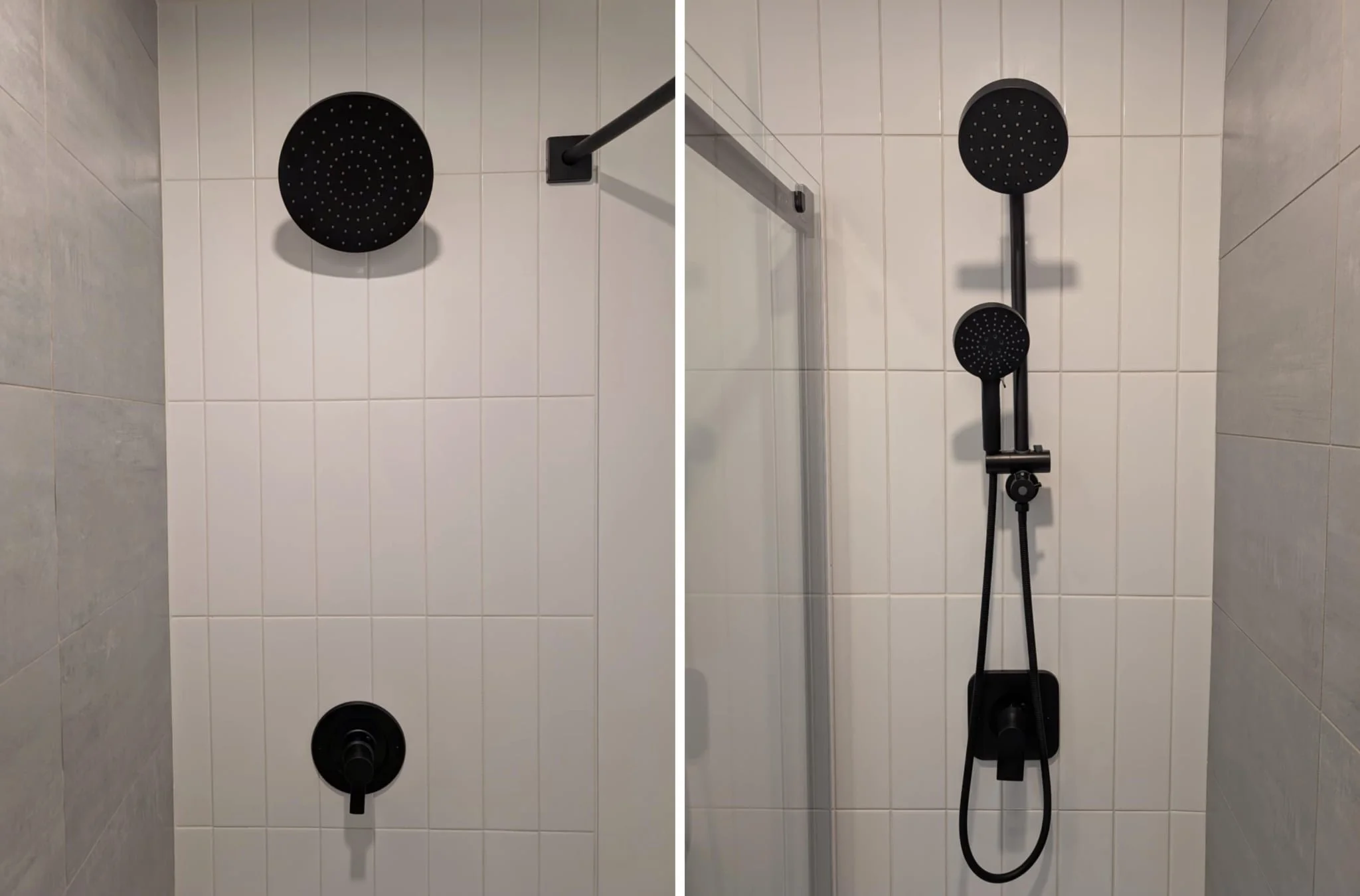
On the left, the original setup; on the right, a shower like God (Amazon) intended.
2. Cheques
When we first started considering emigration seven years ago, we were really obsessed with a blog by another Slovak couple about life in Toronto. The site unfortunately no longer exists, but we still think of them occasionally. One of the completely crazy things to us was that cheques were still actively used in Canada back then. Cheques like you see in American movies, where the main hero pulls out a little book and, instead of an internet banking transfer, fills out a little piece of paper saying, "Here you go, here's some money."
When we were opening an account at a local bank the day after arrival, one of my first questions was, "And do you still use those cheques here?" The advisor just laughed, saying that Canada has long been a cashless economy (unlike the "Era of Cash" in a certain small European country, ahem transaction tax*), and that we wouldn't see many banknotes either.
Well, not exactly. How did we pay the purchase price of our car? Those who guessed "by cheque"—ding ding ding—have the correct answer and an irrelevant plus point. So, instead of three clicks in a phone app, we had to lift our esteemed backsides, stand in line at the bank, explain to a slightly panicked older Asian lady what we wanted, endure 50 apologies for technical problems, explain why we wanted the cheque to the branch manager, sign a money transfer form, pay 10 CAD, and then physically hand over the cheque at the dealership.
The logic of this procedure? Where is it? We don't know, because we paid rent in a substantially higher amount, and we were able to pay that via account transfer.
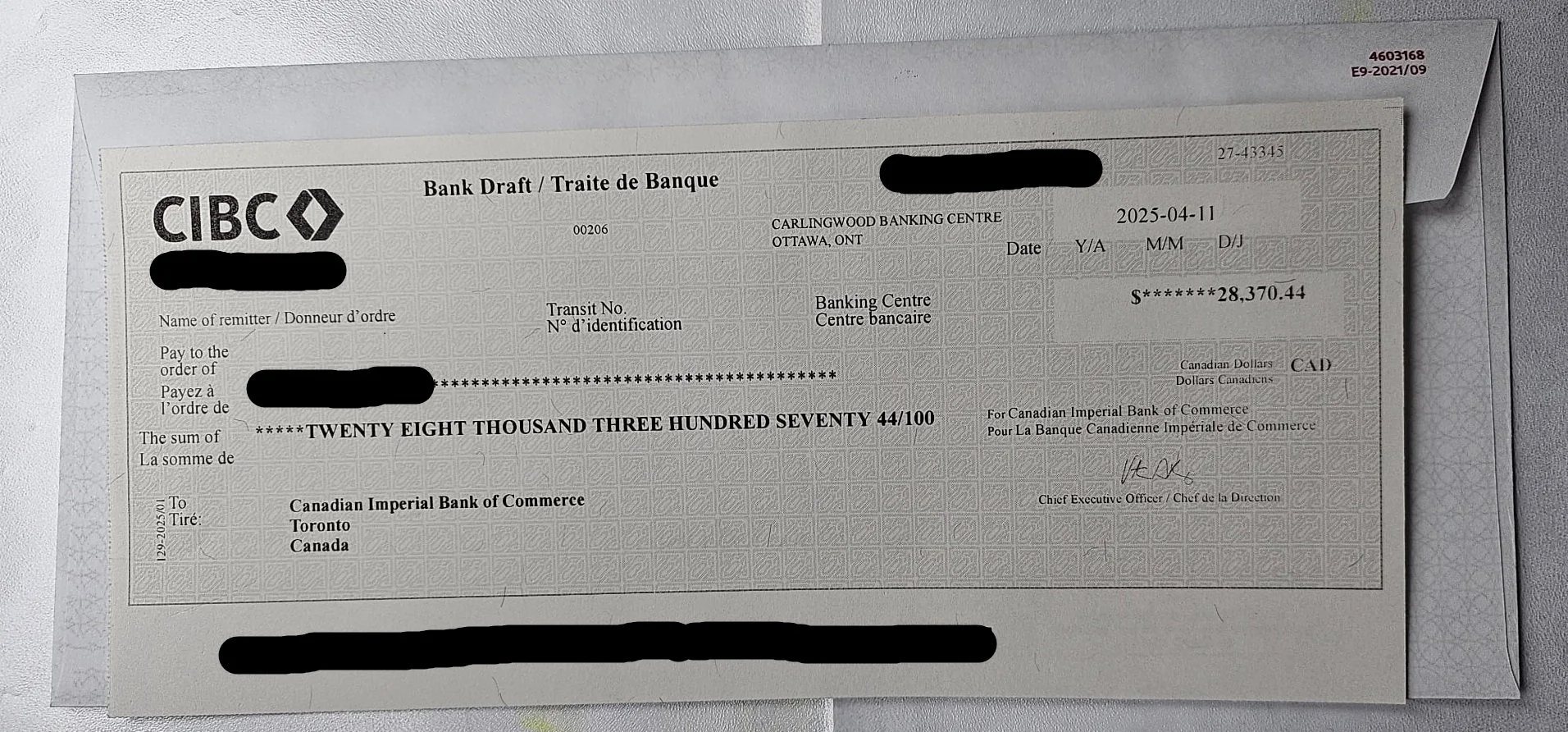
This is a so-called certified bank cheque or bank draft. Immediately after issuance, the money was blocked in the account.
3. Shoulder check
We are all for every driver being careful behind the wheel, being fully devoted to driving, and being considerate of other road users, especially those more vulnerable like pedestrians or cyclists. Anyone who disagrees with this is probably a sociopath, right? But in Canada, they took it to perfection and invented the "shoulder check."
We actively dealt with its existence because of the exams for a local driver's license, and I can freely declare that even as a passenger in the car, it thoroughly annoyed me. Why use mirrors and blind-spot checks when we can look over our shoulder back into the intersection, right?
4. Prices without tax
I don't know if other couples do this, but in Slovakia, we used to play a game in the store to see which of us could more accurately guess the final price of the purchase. Here, we have to take a break from this game, at least temporarily, because price tags in stores are listed without tax, and so we are both way off in our guessing :). Happy that you found a great T-shirt for 20 dollars? BOOM, the final price at the checkout is 22.60 CAD. For more expensive items, such as electronics, the final price can be substantially higher.
As a federal country, Canada has a VAT (sales tax) composed of two parts: federal and provincial. The federal one is the same everywhere—5%. The provincial one is determined by the individual parts of the country themselves. In the case of Ontario, it is 8%, so together it's "up to" 13%. We send greetings home to the 23% VAT and just mention in passing that some provinces have even lower taxes.
Therefore, we could somewhat understand prices without tax for e-shops delivering nationwide. But why, when I go to buy bread in a specific store in a specific city and a specific province, do I find out the final price only at the checkout?
What is even more fascinating is that we have found one exception to the rule so far, and that is the LCBO. The state monopoly with a license to sell hard alcohol, for some reason, has prices listed with tax. I guess it only remains for us to wait and see when the others will follow their example :).
5. Do you have a question? Please contact us at …
In Canada, you are constantly calling somewhere. And when you aren't calling, they are calling you. For example, when moving, we needed to get our internet up and running. I stubbornly ignored all instructions about calling and tried it via online chat. Although we did manage to get a connection, I created unnecessary chaos and, as they say, it took not only longer, but it was also worse :D.
The height of this strange habit was arranging car insurance. We conscientiously clicked through 20 different packages and add-ons, only for a message to pop up at the end saying that the insurance cannot be finalized online and we have to—what? Yes, call.
After connecting, the operator literally read back all our chosen conditions and add-ons, asked about twice if we "really really" wanted this insurance, and only after our approval was it finally possible to make the payment (at least they didn't want a cheque from us, haha). She also explained to us that this is the standard procedure for all "first-time insurees."
I should have suspected it back when Air Canada forced me to call the customer line because of a flight ticket for the dog.

6. Small cans for dogs
Even small doggies like ours need to eat. For us owners, this naturally means planning supplies so that the animal isn't hungry. In Slovakia, we used to buy 800g cans. In combination with kibble, one can easily last us 3-4 days. Well, we can probably say goodbye to that for good.
In Canada, large cans do not exist. We’ve been to pet shops as big as the Tesco on Kamenné Námestie in Bratislava, but we haven't found a single can larger than 369g (13oz). Meanwhile, the price for half the volume is the same, and I’d rather not even talk about the unnecessary waste. At least Foxi is super excited about them.
I would like to know how many cans per month owners of Malamutes or similarly large dogs buy.
7. Unnecessarily large data volumes in plans
Canadians have apps for everything and love tapping away on their phones (not excluding behind the wheel)—that’s just a fact. Even so, I don't understand how one can use 75GB of data per month. And that is the smallest possible data volume we could choose in our plan.
For our bundle, which includes unlimited calls and texts in addition to that data, we pay 43 CAD, which is about 27 euros. Is it a lot? No. Do I need such a plan? No. Can I lower it to save money? Also no.
8. Credit Cards
Credit cards are such a huge part of everyday life here that they perhaps deserve a separate article. I won't give the banks that much joy yet, though :) A credit card in itself isn't a bad invention; after all, it gives you access to the bank's money. The problem only arises when you live in a society literally obsessed with credit cards.
To put it simply, you won't get anywhere here without a credit card. We experienced this during our first week in Canada when we had Canadian debit cards, but they had to put our credit cards into production. Right around those days, we needed to rent a car (yes, that famous car with the non-extended license plate). The first thing rental agencies here will want from you is two pieces of photo ID. The second is a credit card issued in the driver's name. We didn't have that, as the cards were still in production. And it was an almost insurmountable problem. Although a classic embossed debit card from Slovakia passed without problems in a rental shop in Toronto, in Ottawa, the lady behind the counter had to talk her boss into it. Even so, they were verifying whether we hadn't made up the car rental in Toronto and whether they really gave us a car on a pathetic debit card. Absolutely incomprehensible.
Whether you are paying by credit or debit card is actually a significant question here even when buying ordinary groceries or toiletries. And if you happen to make a mistake and pay with the other card, your payment won't go through. Nowhere in Europe have we encountered the question "Credit or debit?" and we functioned happily there for 30 years.
Similarly to how you are forced to pay for nonsensically large data plans, you are also forced into using a credit card here. If you let it collect dust, or perhaps never set one up, you won't have a good Credit Score. Without a good Credit Score, no one will rent you an apartment, nor give you a car lease, and they say in some stores they won't even sell you furniture. But consider that last one an urban legend; we don't have experience with it ourselves, we just heard it from a neighbor.
Do you know the episode "Nosedive" from Black Mirror? That’s probably how people without a credit score feel here. Which means every newcomer, including us.
9. (Non)mandatory tipping
Imagine an ordinary cafe. You come to the counter, dictate your order to the barista—say, an espresso to go—the barista taps the code into the register, you pay, take your To-Go cup, and walk away satisfied.
The barista did their job and you paid for it what the cafe asked. Except that a certain "unpleasantness" has spread here... tipping. A priori, we don't have a problem with tipping. We've experienced service here that attended to us and was almost annoying because they asked us every 2 minutes if everything was okay and if we were missing anything. Such an approach certainly deserves a few extra coins. But asking for a tip for literally doing one's job seems a bit "too much" to us. The example above is not embellished or dramatized at all—that’s just how it is here. 99 percent of establishments will offer you a terminal when paying that prompts you to enter the tip amount. And many times this step cannot even be skipped, while we are talking about a range from 2% to 25%. Like, seriously?
10. Miško’s Choice: STOP signs
In Canada, the main road is not marked. Yes, exactly—the "priority road" sign does not exist here. So how do things work? Traffic lights. The vast majority of intersections here have light signals. The problem arises where there are no lights, meaning secondary roads like residential areas or parking lots. In Europe, in such a case, I simply look for the main road sign, and if I don’t see it, I follow the "give way to the right" rule.
Here, intersections without lights are almost always marked with stop signs, which actually determine the main road. Meaning, if your lane has a stop sign but the one next to it doesn't, the cars in that lane have priority. So far, so good.
But what happens if there are multiple stop signs? Who has priority then? You say the one coming from the right. Incorrect. Then the one who isn't turning? Also incorrect. The one who arrived at the stop sign first goes first. Done, that's the whole rule: first come, first served. But what if two cars arrive at the intersection at the same time? Well, then it looks something like this. An incredible piece of nonsense; this really can only work in a country like Canada. How is it that there aren't accidents everywhere? Well, because almost every driver actually obeys those stop signs.
Because it holds true that the kind of person you are is the kind of driver you are. And here we are in Canada, so politeness is on the roads too. Unless an Indian or a Quebecer is currently overtaking you :).
Authors’ notes:
*transaction tax - tax imposed in Slovakia as of April 1, 2025. Companies and freelancers have to pay 0.4% tax from banking transactions including sending salaries to your employees. The tax is even higher for cash withdrawals from company accounts and sits at 0.8%.