

On Travelling with a Dog to Canada
What stressed us out the most about moving to a different continent? Was it the flight? The visa check? Finding a job in a foreign country? No. It was the idea of flying with a dog.
We see Foxi as a member of the family, so leaving without her was out of the question. Since there is very little information on this topic on the Slovak-Czech internet (and even less of it is up-to-date), I decided to write down the process and what it all entails.
We flew with Air Canada. Other airlines may proceed differently, but many things will be the same regardless of who you fly with. Foxi and her crate did not meet the dimensions for carry-on baggage—those are generally very strict—so she traveled in the cargo hold.
1. The very first step is to buy your own ticket and then call the call center to add the dog to the reservation. My original plan—to check in advance if it was possible to book a dog for our flight—failed due to how busy the customer line was 😊. However, Air Canada offers a so-called 24-hour "grace period" during which you need to add the dog; if it isn't possible, they will cancel the tickets for free.
After buying our tickets, I tried calling for about 5 hours but was unsuccessful. Michal couldn't stand watching my absolute frustration anymore and suggested contacting AC via Facebook. I didn't believe it myself, but in the end, we added Foxi to our tickets exactly that way.

2. Since it seemed batshit crazy to me and I had no official confirmation other than the FB chat, I tried calling again the next day. I got through immediately, and the operator confirmed that we did indeed have the dog added to the ticket. Later, I discovered that the dog in the cargo hold could also be seen in "Manage Booking" on the AC website. In addition to this check, I asked about the carrier's conditions for transporting live animals, to which I received the answer that a certificate from a veterinarian is required.
3. Do you know what titers are? Neither did we 😂. We learned about the existence of titers from our vet when we asked if we should give Foxi sedation medication before the flight. In short, titers are an examination of rabies antibodies. The result is then recorded in the passport. In Slovakia, only one accredited laboratory in Zvolen does it, and since we were just having Foxi put under for a teeth cleaning, we would have had to wait 2 weeks for the titer test. The vet estimated the total time for entry into the passport at 7 weeks. Yes, you read that right 😊. Seven. We digested this information with our "cheeks clenched" because it timed out exactly with the expiration of our visas.
I must admit that our vet and his entire team were truly persuasive and persistent that without titers, they would leave the dog in a 30-day quarantine at the airport. In the period before departure, we visited them several times, and during every single visit, they kept telling us "titers here, titers there, titers everywhere." Apparently, Dominika Cibulková* had them recorded in her passport. Too bad she flew to the USA and not Canada.
This surprised us a lot because, of course, we had done some research beforehand, and government websites stated that a dog needs a pet passport with valid rabies vaccination to enter Canada, and that’s it. To be safe, I contacted the Slovak embassy in Ottawa; they told me to contact the Canadian embassy in Bratislava, and they told me to contact the Canadian embassy in Vienna. At this point, I had at least twice as many gray hairs as at the beginning. Really pissed off, I found the email for the Canadian Veterinary Authority, wrote to them about our situation, and ta-da—within 45 MINUTES (yes, minutes), I had an answer: titers are NOT needed if you are taking the dog as a pet and not for commercial purposes (e.g., breeding in Canada).
Slovak mentality, of course, didn't let up, and our vet and his staff kept insisting on their own version and didn't believe us 😊. You can read below how the actual dog inspection at the border went.
4. The day before departure, we went to the vet for the last time. They did a standard health check (checking temperature, lymph nodes, heart, eyes, any injuries) and we got a stamp in the passport stating she was fit to travel. We said for the last time that we didn't need titers, and thus our entry formalities were settled.
5. Generally, to enter Canada, you need to make a customs declaration, which I strongly recommend doing at home in comfort via the ArriveCAN app. A live dog used to fall under the category of "meat," but now there is a separate "live animal" column. If you do the declaration online, after arriving in Canada, you scan your passport at self-service kiosks; the kiosk then takes your photo and, after identity verification, prints a slip with photos and codes. Based on this, an airport employee will mark that you have a dog during a personal interview. You move everywhere with this slip until they finally let you out through the last check.
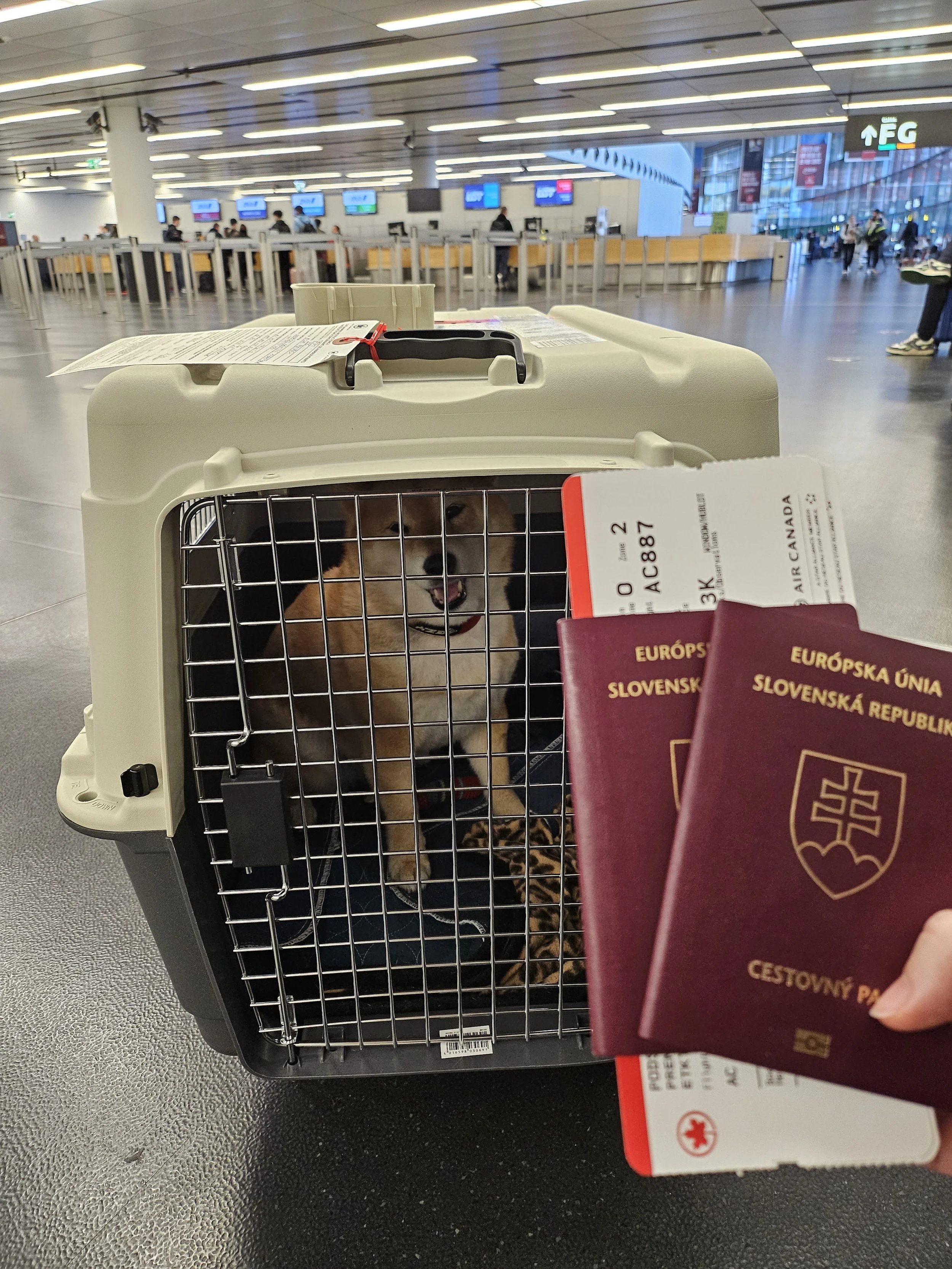
Waiting to hand over the crate for the plane.
6. Foxi got her last food the evening before departure. In the morning, we only gave her a sedation pill and a few treats. Right after giving the meds, we went for a walk (while she could still walk 😊). The effects started after about 2 hours; after 4, she was completely K.O., which worked out perfectly for the moment of handing her over at the airport.

The meds are really kicking in.
7. If you are traveling with an animal, AC will not allow you to do an online check-in. In our case, there were 2 passengers on the ticket; it let me do the entire online check-in, including the boarding pass. Michal had Foxi added, so a notification popped up for him to find a staff member at the airport. There we filled out one more form that stayed with the crate during the entire journey. We stated whether she received sedation meds, what her name is, what her routine is, and so on. Subsequently, we received zip ties to secure the cage and paid a fee of 205 euros.
8. From the counter, we all moved to the oversized baggage area where they weighed Foxi first separately and then with the crate.
9. The check-in staff gave us a great tip to put ice in the bowl in the crate instead of water, which we did immediately. We were finally able to wait with Foxi until an hour before departure. During that time, a flock of Japanese flight attendants heading to Tokyo passed by and were absolutely delighted by our "mutt" (the Shiba is an ancient Japanese breed). Generally, wherever we go, we attract attention, so in addition to the flight attendants, American passengers also spoke to us. After the answer that she would be flying 9 hours to Toronto, they started pitying us terribly and saying how they wouldn't be able to do it with their dogs. Bitch, I know but I have no other option so shut up. Overall, the bulk luggage department was super busy that day because we just happened to catch a Christian orchestra returning home to the USA, so we sat there with a drugged-up dog among trombones and violins 😂.
10. Finally, the "Hour H" and "Time T" arrived when the bulk luggage employee came for us, saying all the violins had been handed over and it was time to hand over our doggy too. We secured the crate with zip ties. We agreed that Foxi would go through the X-ray check because then they leave the dog in the crate and nobody takes them out.
11. After handing her over to the airport staff, she appeared in the app as baggage almost immediately, except that the tracking in Vienna didn't work😂. Only at this moment, exactly one hour before departure, could we go through security. It was a bit tight; by the time we did a mandatory bathroom run and packed all our junk after the check, boarding was already open and we boarded among the last in our class.
12. Having learned from internet discussions, I picked out a kind-looking steward. I explained to him that we had a dog downstairs and asked him to verify that the pilot knew about her and that she was loaded on the plane with us. The guy looked at me a bit confused and stated that while that's great, I should have asked at the gate. At the same time, however, he reassured me that as long as we had her in the app, there was no reason to fear she wasn't on the plane. But that's easier said than done.
As I was processing this information and playing out all the scary scenarios in my head, a ground staff member in a reflective vest suddenly walked up to me and showed me a photo on his phone of the crate secured with a strap in the plane. I won't lie—I shed a tear or two out of relief and emotion 😊.
13. After landing in Toronto, the tracker activated, and by the time we passed through visa control, I knew exactly where Foxi was placed and also where our suitcase was. Btw, the crate was just sitting there next to the luggage belt. By this time, the meds were no longer working, so Foxi was happy but already trying to scramble out of the crate. During that whole time, she didn't pee, poop, or puke, so I officially award her a "Heroism Award."
14. So, how did the border control itself go? Just before the exit from the airport, they diverted us to the department where baggage is cleared through customs. After standing in line, the check lasted about 35 seconds. The officer didn't look at the health certificate at all and only checked the rabies vaccination with one eye. He just asked us why we were in Canada, and that was it. So much for those titers, Mr. Veterinarian 😊.
15. The last point concerns a pet-friendly hotel at the airport. We stayed one night at the Alt Hotel Toronto and I can truly only praise them. Our dog has been with us here and there, but we have never before found a prepared care package in our room—a bed, bowls, and treats. Yaay!

Happy Foxi in the hotel’s room
I understand that this topic is super specific and only interests a certain group of people; at the same time, it’s hard to find anything about it. I would have welcomed all this information myself before the trip. However, I had to experience it for myself 😊.
So, we handled traveling with the dog with an A+. Despite how neurotic and "autistic" she is, she has no lasting effects, and everything actually went smoothly for us, for which we are incredibly grateful. Regardless, I hope we won't have to undergo this ordeal again, and if so, then at most with a puppy that fits under the seat in front of us.
And if I were to recommend anything, it’s only that it’s worth investing in Priority Boarding. We traveled in Premium Economy class, and besides having much more comfort ourselves, we were among the first to get off the plane and beat the crowd at visa control. Within about 20 minutes, we were already at the crate (here it must be taken into account that we were on work visas, which involve an extra check compared to tourists).
It cost us a lot of extra money, of course, but what wouldn't you do for your dog, right?

Catering in Premium Economy class.
Authors’ notes:
*Dominika Cibulková is a former Slovak tennis player who ended her professional playing career and now spends majority of her time influencing people. With rather dubious results.